A Kubrick-Inspired Genesis Film · December 2025
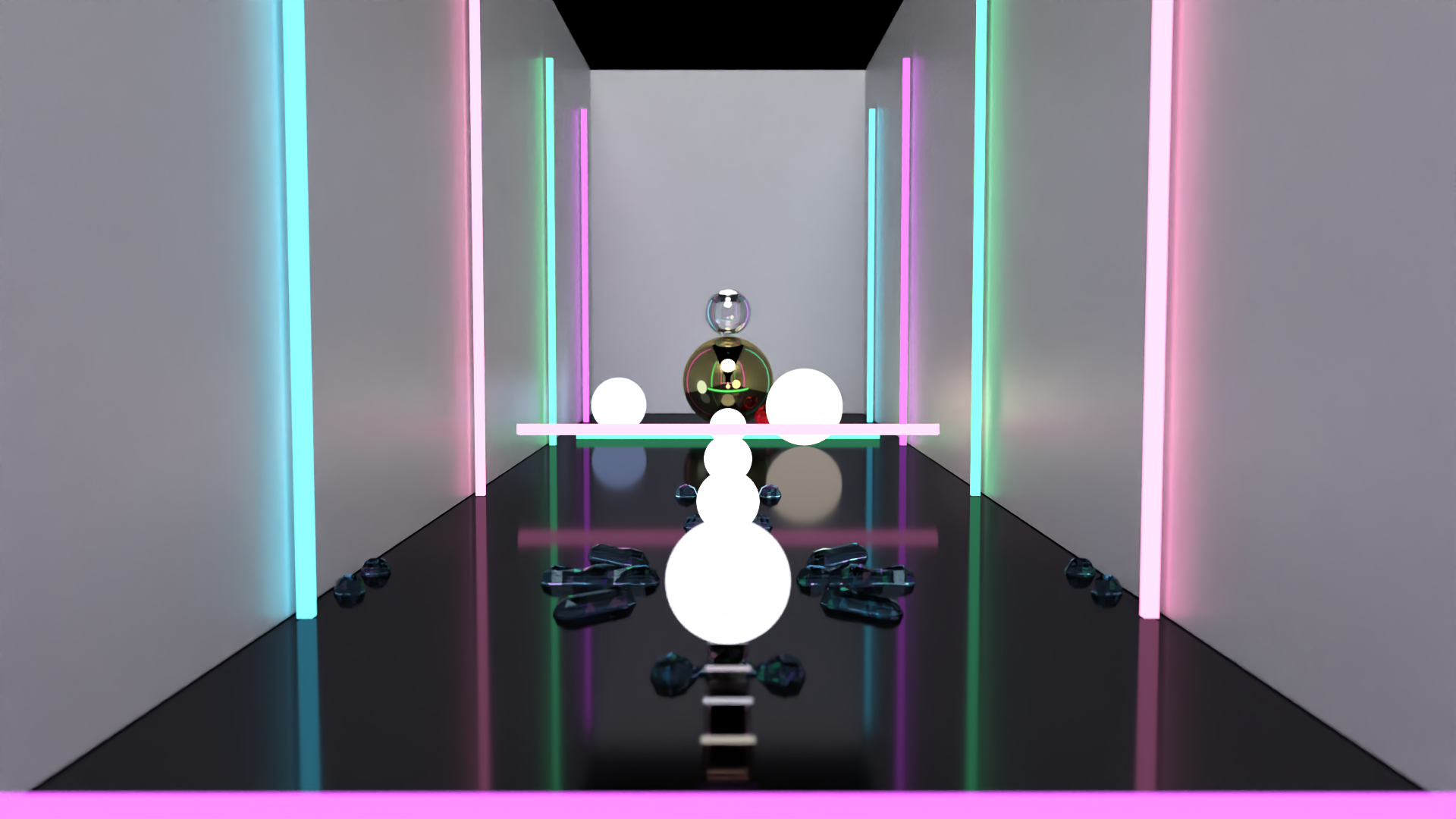
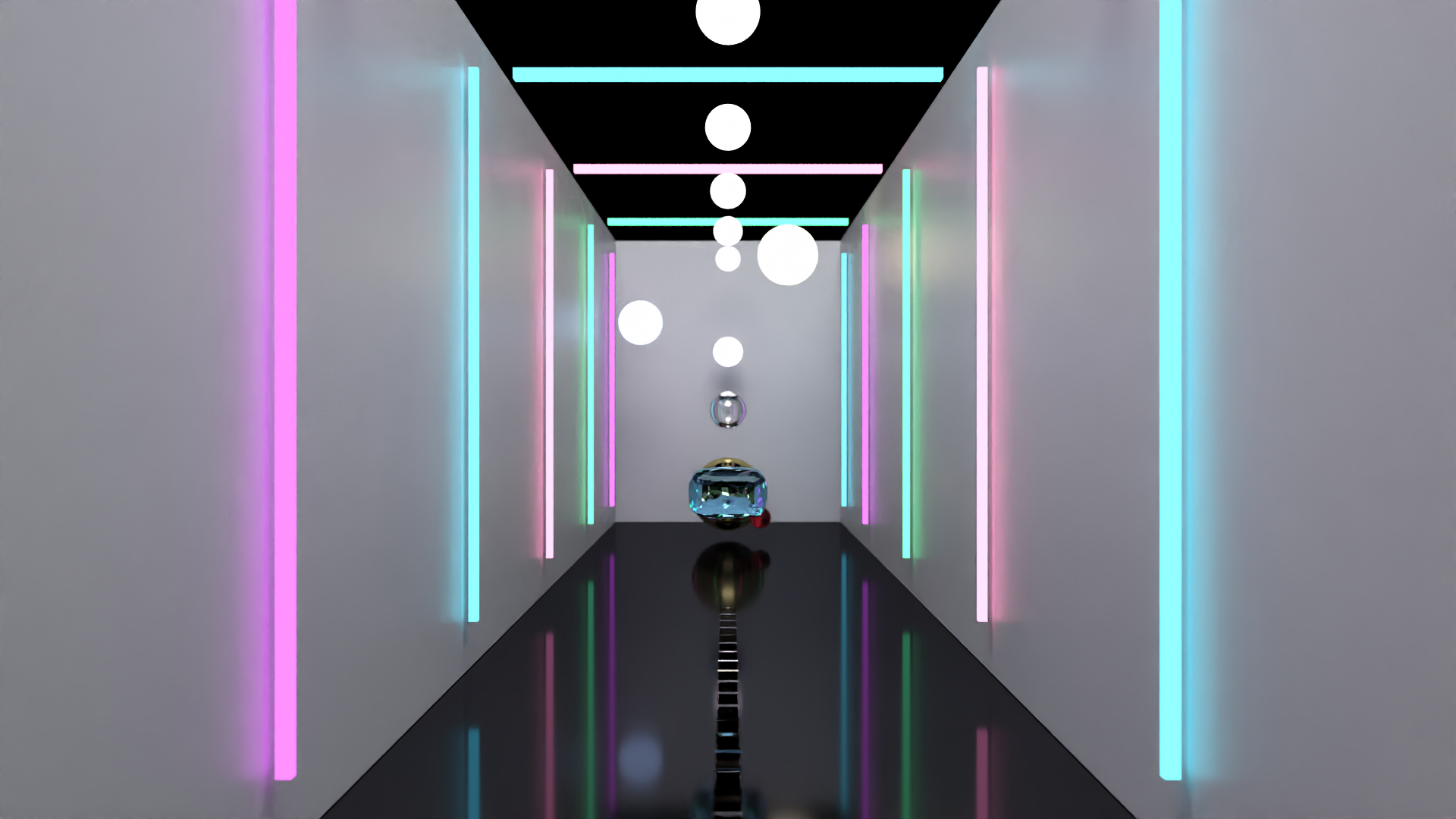
The opening frame establishes perfect one-point perspective—every line converges to a single vanishing point at the corridor's end. This is Kubrick's signature visual language, seen in The Shining's Overlook Hotel.
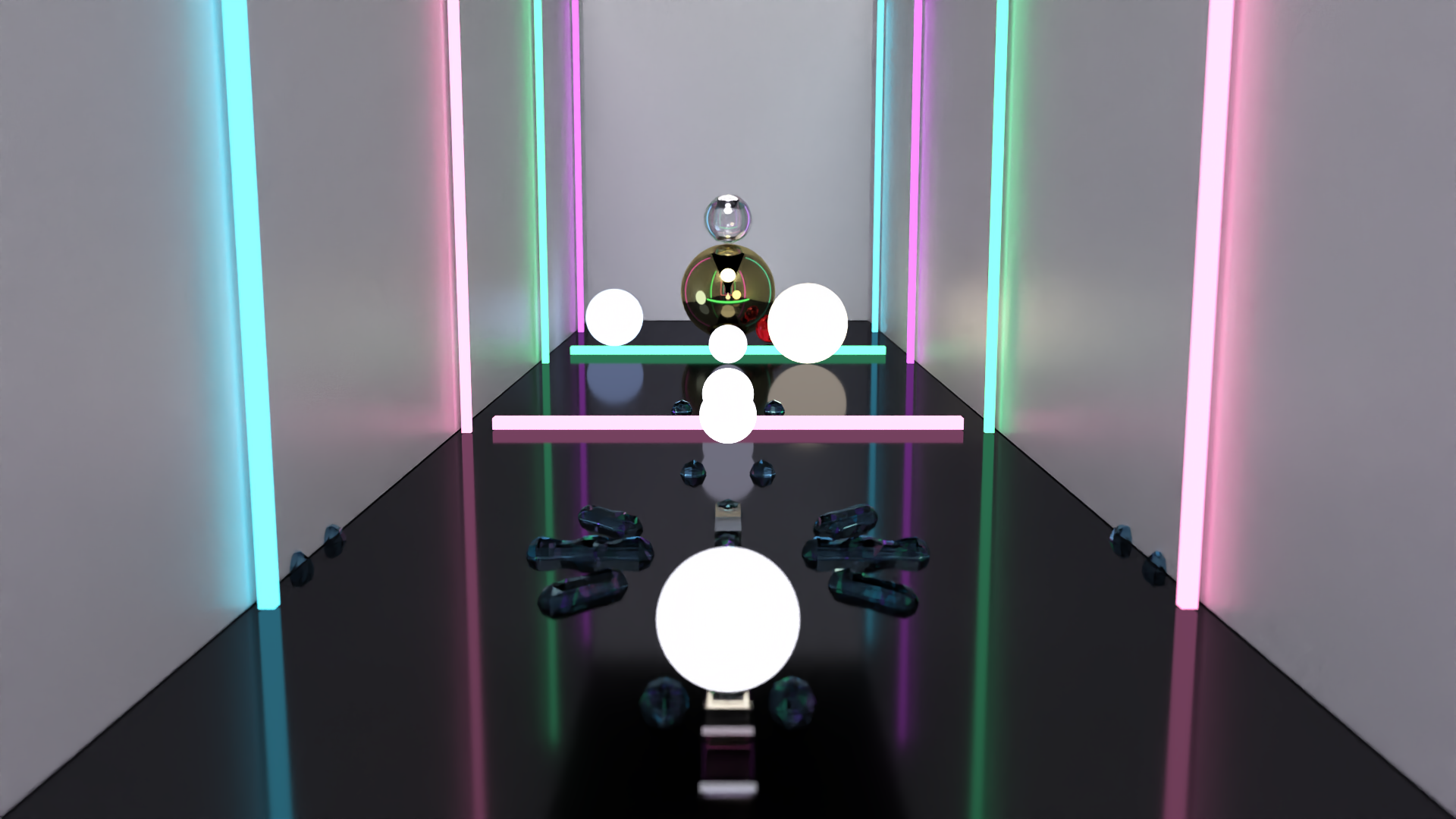
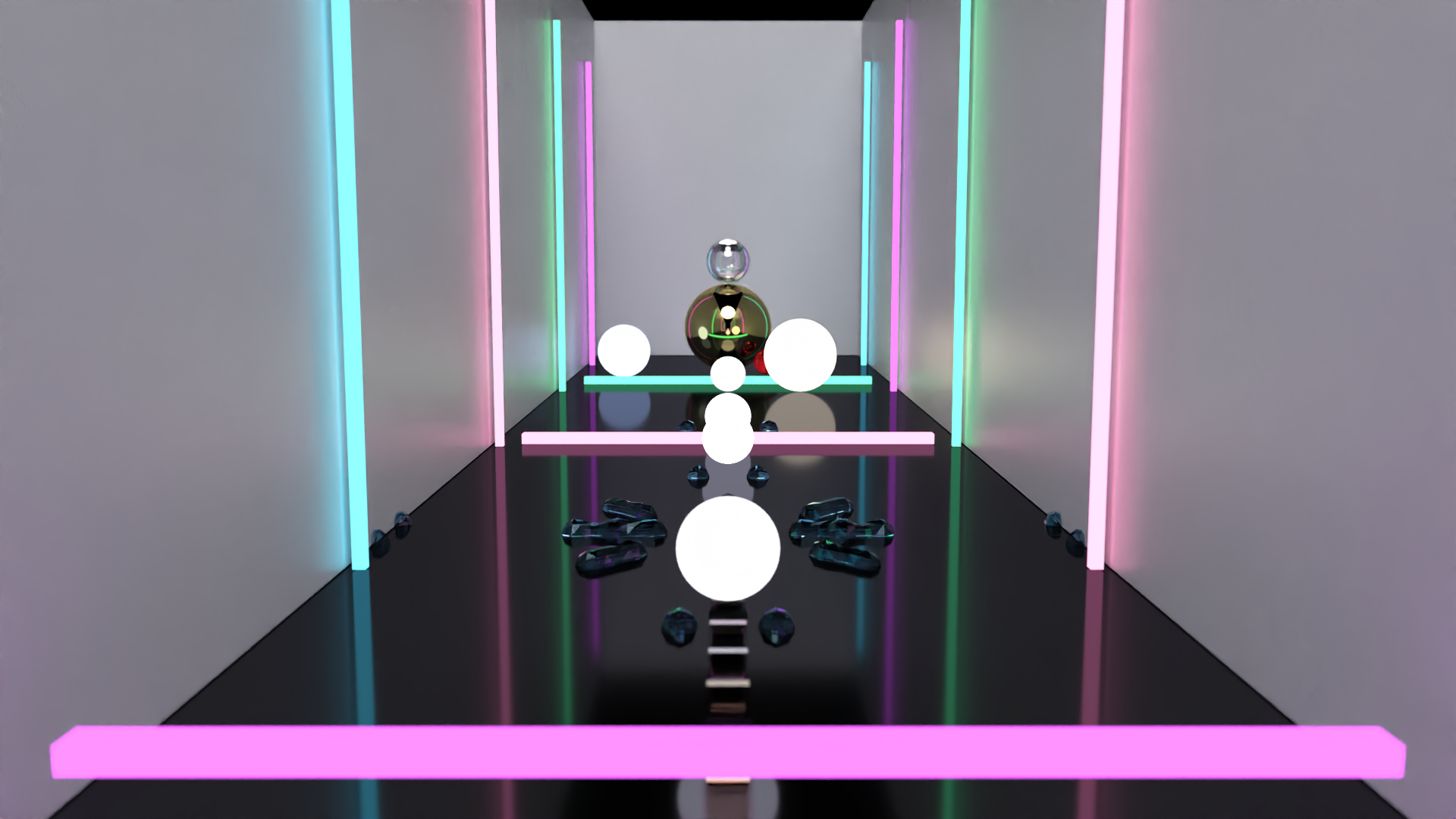
Notice the bilateral symmetry: neon bars on the left match those on the right, ceiling lights recede in perfect rhythm. The obsidian floor acts as a mirror, doubling the geometry and creating infinite depth.
The ceiling lights don't just emit—they bounce. Each white sphere casts light that reflects off walls, floor, and other surfaces. This is path-traced global illumination: 12 bounces of physically accurate light transport.
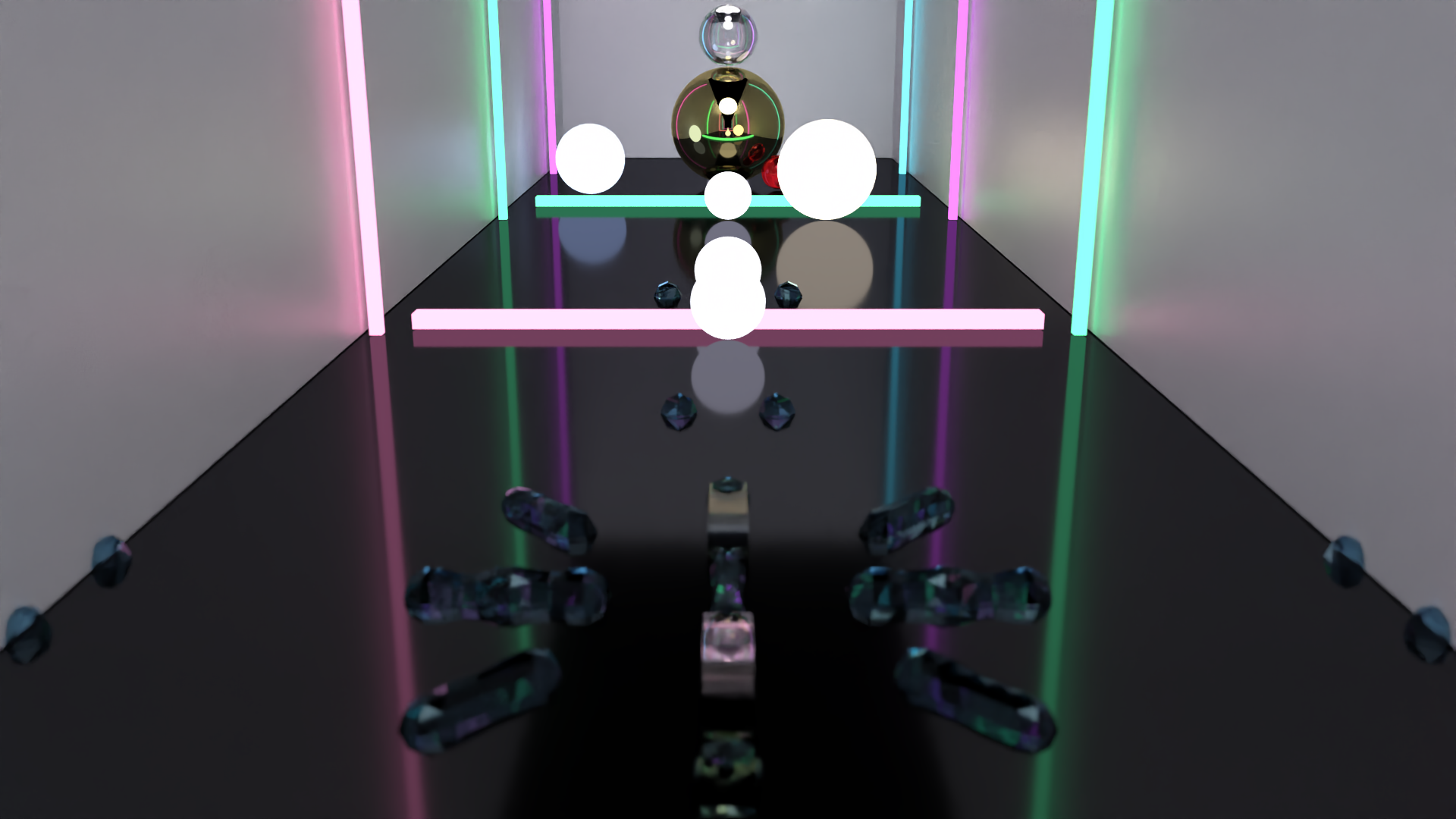
The obsidian floor has a roughness of 0.08—nearly a perfect mirror. Light rays hitting this surface reflect at the incident angle, creating sharp reflections of the neon bars, ceiling lights, and crystal dominoes.
In the BRDF, low roughness means the microfacets are nearly aligned. The GGX distribution produces physically accurate specular highlights.
Reflections are stronger at grazing angles (near the camera) and weaker when looking straight down. This is the Fresnel effect—all materials reflect more light at shallow angles.
The Schlick approximation models this: reflectance increases as the view angle approaches 90°. Even non-metallic surfaces become mirrors at the horizon.
The cascade from order to chaos across 15 seconds
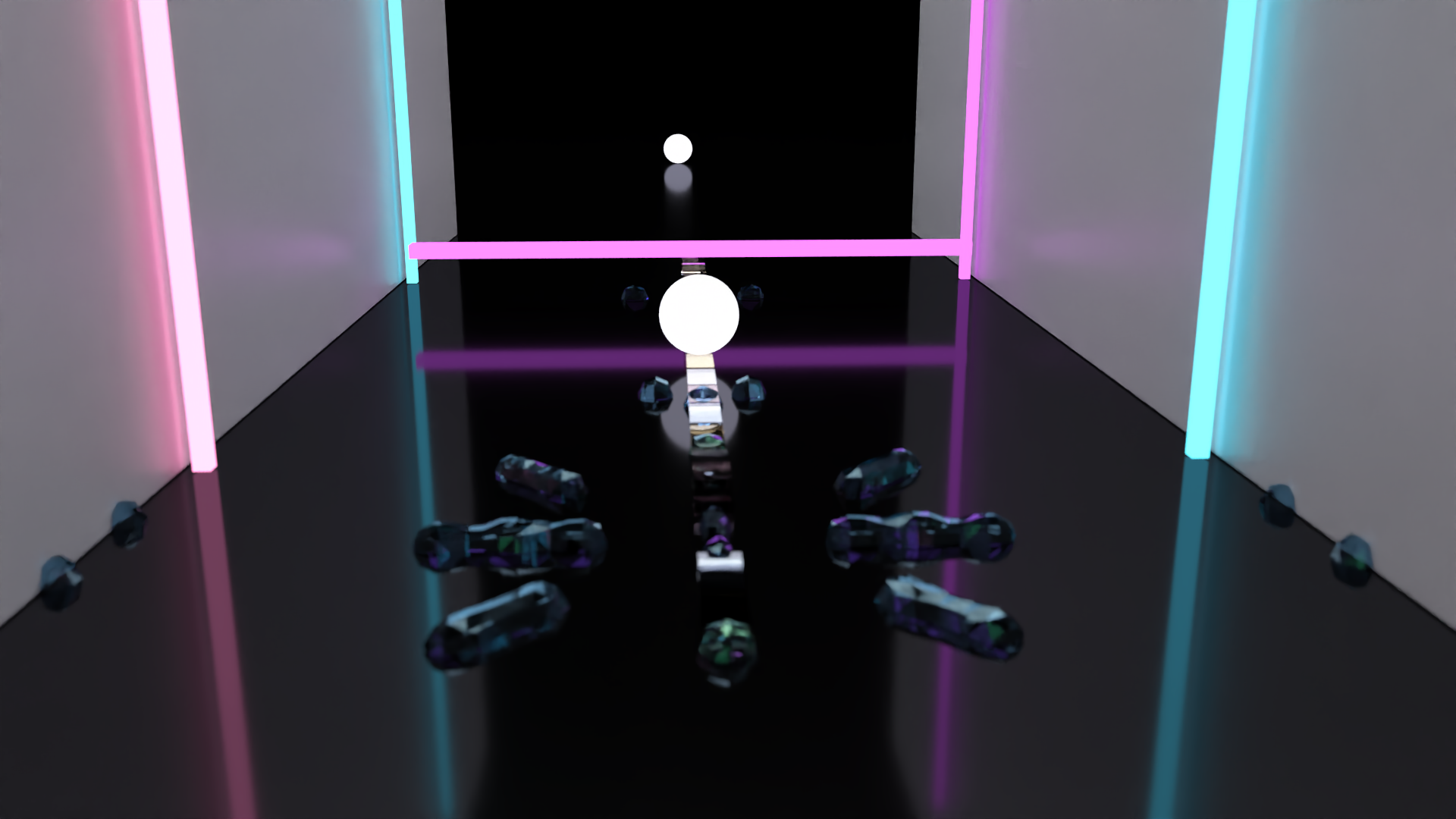
Each domino is a physics object with mass, moment of inertia, and collision geometry. Genesis solves Newton's equations of motion at 60 Hz (16.67ms per physics step).
The cascade isn't scripted—it's simulated. The first domino receives an initial velocity impulse, then pure physics takes over.
Every frame, Genesis checks for interpenetration between all rigid bodies. When dominoes collide, the impulse response is computed: how much velocity to add to separate them while conserving momentum.
Each domino is rendered as glass with physically accurate Index of Refraction (IOR):
At steep angles inside glass, light can't escape—it bounces internally. This creates the bright edges and sparkle in the crystal dominoes.
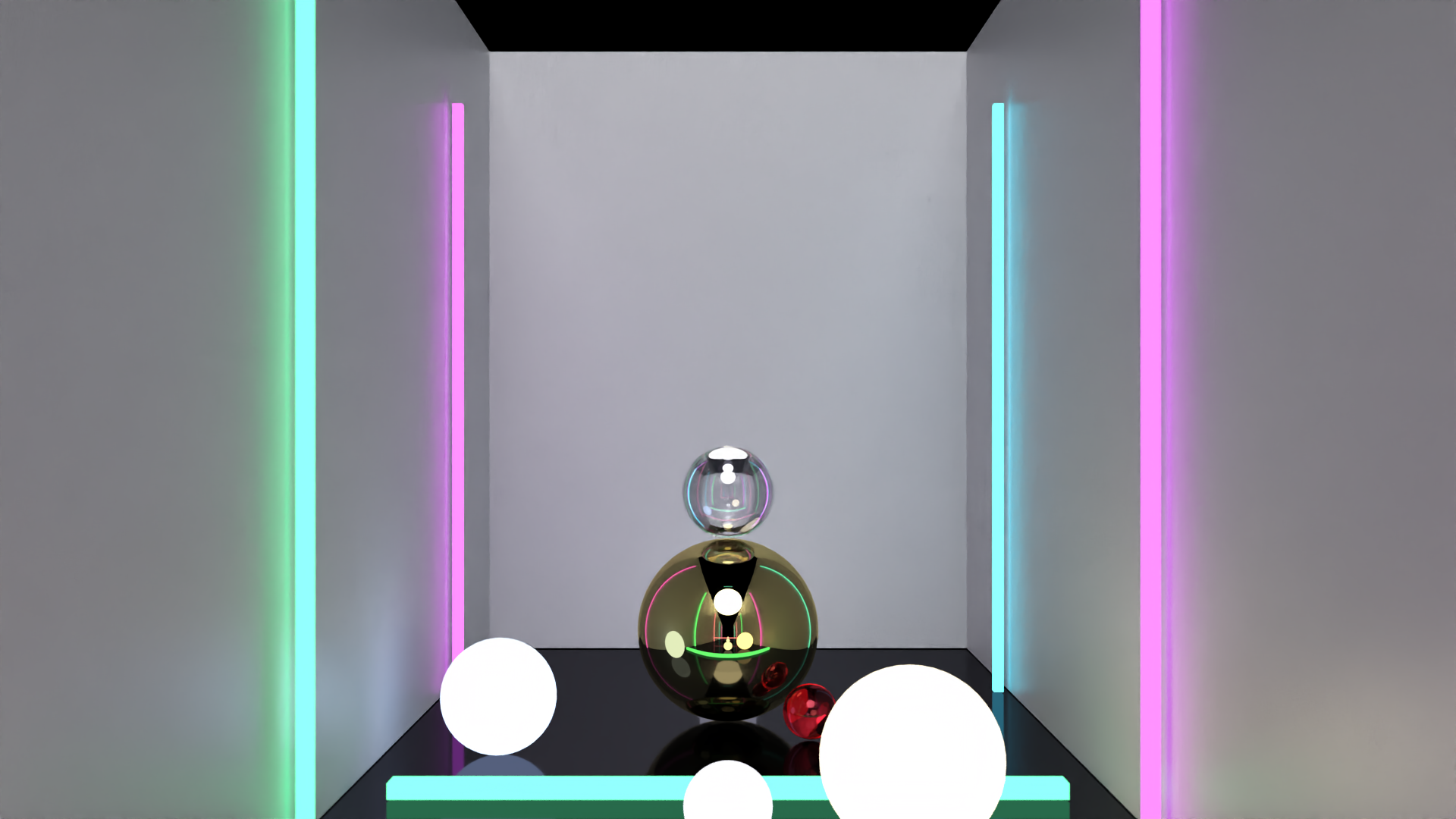
"The gold sphere reflects everything. The diamond refracts everything. Together, they are the eyes of the corridor."
Camera advances slowly down the corridor. Deep focus keeps everything sharp. FOV 32° creates compressed perspective.
Focus shifts from 1m to 9m. Foreground blurs, background sharpens. f/1.4 aperture creates extreme bokeh.
Camera retreats while FOV increases (30°→70°). Subject stays same size, background warps. The "Vertigo effect."
Smooth path through the chaos. Camera weaves between fallen dominoes, maintaining focus on the hero elements.
Camera arcs 40° around the center. The background slides, creating parallax. A reveal of the final state.
f/2.0 aperture blurs the neons into soft circles. Out-of-focus highlights reveal the aperture shape.
"The dominoes didn't fail—they transformed. Each one found a new position, a new relationship to light, a new way to refract the neon glow. Entropy isn't destruction. It's redistribution."
Understand the rendering pipeline: path tracing algorithms, denoising, physically-based materials, and the Genesis physics engine.
Enter Technical →